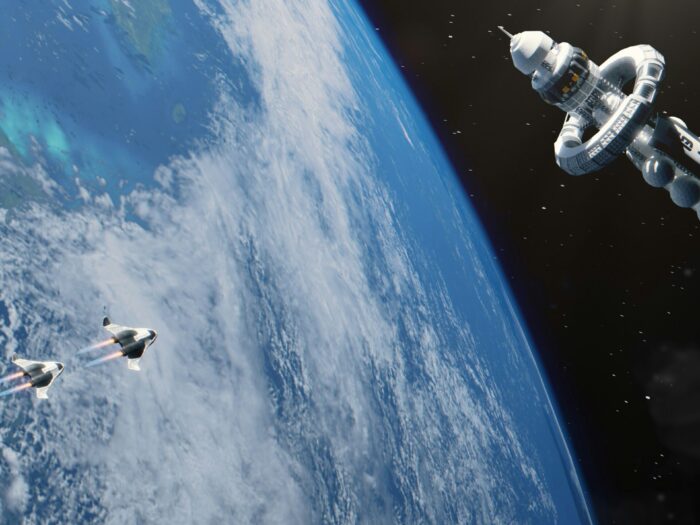
In a disclosure that experts are calling a turning point for global security, the United States has publicly confirmed — for the first time in its history — that it has operational weapons deployed in Earth’s orbit. The announcement came from Air Force Secretary Troy Meink during a keynote address at the Air & Space Forces Association’s Air, Space & Cyber Conference in National Harbor, Maryland, on September 14, 2026.
“Today, we continue to ensure we remain ready to meet the challenges of evolving threats wherever they exist,” Meink told the audience of defense officials and industry leaders. “This is why the Space Force now has on-orbit space control weapons capable of defending the joint force against hostile adversary action.”
What Exactly Did the US Confirm?
Meink’s statement marks the first time any US official has openly acknowledged that the country has weapons stationed in space — a capability that has long been suspected but never formally admitted. He offered no specifics about the type, number, or location of the weapons, saying only that his choice of words was “very well thought out.” Officials later clarified that these systems fall under the umbrella of “space control weapons,” a category that can include kinetic, electromagnetic, and cyber-based tools designed to disable or destroy adversary satellites and spacecraft.
A follow-up statement from a US Space Force spokesperson expanded slightly on the announcement: “The US has on-orbit space control weapons capable of defending the Joint Force against hostile adversary action. Space control encapsulates the mission areas required to contest and control the space domain — employing kinetic and non-kinetic means to affect adversary capabilities. These capabilities can be employed for offensive and defensive purposes.”
Space security analysts believe the weapons are more likely electronic or cyber-based systems rather than kinetic ones capable of physically destroying satellites, though the Pentagon has not ruled anything out.
Why This Announcement Matters
Space has quietly become one of the most contested military domains of the decade, with the US, China, and Russia all racing to secure dominance above the atmosphere. Until now, Washington had avoided officially confirming it possessed offensive or defensive space weapons — even as it repeatedly accused Moscow and Beijing of developing similar capabilities.
In 2024, the US warned that Russia had deployed a satellite capable of attacking other spacecraft, and separately cautioned about alleged Russian plans to place a nuclear-capable satellite into orbit — claims Moscow dismissed as a “ruse” while blocking a related United Nations resolution.
Victoria Samson, a space security expert, called the timing and substance of the announcement significant. “That’s huge, because I don’t think any US government official has ever said that before,” she said. “The US also now has to accept the Chinese and Russians doing and saying the same. I don’t think that this is going to be in the interest of US national security.”
Her concern reflects a broader anxiety among analysts: that by breaking the decades-long silence around space weapons, the US may have opened the door for rivals to openly showcase — and expand — their own orbital arsenals, accelerating a space-based arms race that has so far played out mostly in the shadows.
The Bigger Picture
Secretary Meink’s disclosure carries added weight given his background. Before being confirmed as Air Force Secretary in 2025, he served as principal deputy director of the National Reconnaissance Office, giving him direct insight into the US government’s classified space programs. His decision to speak publicly, rather than continue the Pentagon’s traditional silence on the topic, suggests a deliberate shift in strategy — one aimed at signaling strength and deterrence rather than concealment.
For now, key details remain undisclosed: how many space weapons the US has deployed, what orbits they occupy, and whether their effects are reversible or permanent. Officials have indicated that no further specifics will be released in the near term, keeping the exact nature of America’s orbital arsenal classified even as its existence is now public knowledge.
What is clear is that the announcement marks a new phase in space policy — one where the world’s major powers may increasingly move from denying they have weapons in orbit to openly discussing them as a matter of national defense strategy.
This is a developing story and will be updated as more information becomes available.