Space is stranger than any science fiction movie. Some mind-blowing space facts sound so wild that you’d swear someone made them up, but every one below is backed by real science and NASA-level research.
Ready to have your mind blown? Scroll through all 25, then test yourself with the space quiz at the end.
In this post:
- Planet facts
- Sun, Moon & Earth facts
- Stars, black holes & the universe
- Weird space facts
- Quick space quiz + FAQ
Planet Facts That Sound Fake
1. A day on Venus is longer than its year
Venus spins so slowly that one full rotation takes about 243 Earth days, but it circles the Sun in only 225 Earth days.
2. Venus is hotter than Mercury
Mercury is closer to the Sun, but Venus’s thick carbon dioxide atmosphere traps heat, pushing surface temperatures to about 465°C (870°F). That’s hot enough to melt lead.
3. Saturn could float in water
Saturn is mostly hydrogen and helium, so its average density is lower than water. You’d just need a bathtub big enough.
4. Mars has the tallest volcano in the solar system
Olympus Mons rises about 22 km (13.6 miles) high. That’s roughly two and a half times taller than Mount Everest.
5. Sunsets on Mars are blue
Martian dust scatters light differently from Earth’s atmosphere, so the sky near the setting Sun glows blue while the daytime sky looks butterscotch.
6. It may rain diamonds on Neptune and Uranus
Scientists believe extreme pressure deep inside these ice giants can squeeze carbon into diamonds that slowly sink toward the core. Lab experiments have backed this idea.
7. Jupiter’s Great Red Spot is a storm older than most countries
This giant storm has been observed for more than 150 years and is wider than Earth, though it has been slowly shrinking.
Sun, Moon & Earth Facts
8. The Sun holds 99.86% of the solar system’s mass
Everything else, including all the planets, moons, and asteroids, shares the remaining 0.14%.
9. You see the Sun as it was 8 minutes ago
Sunlight takes about 8 minutes and 20 seconds to reach Earth. If the Sun vanished, we wouldn’t know for a little over 8 minutes.
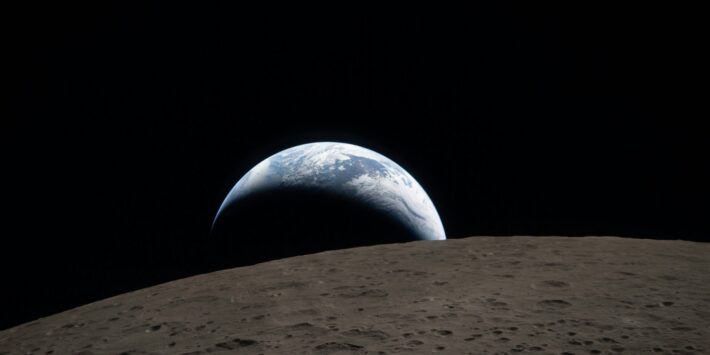
10. The Moon is drifting away from us
The Moon moves roughly 3.8 cm (1.5 inches) farther from Earth every year, about as fast as your fingernails grow.
11. Footprints on the Moon could last millions of years
With no wind or water to erode them, the Apollo astronauts’ footprints are expected to remain for a very long time.
12. Astronauts get taller in space
Without gravity compressing the spine, astronauts can grow up to about 2–5 cm taller. They shrink back after returning to Earth.
Stars, Black Holes & the Universe
13. A teaspoon of neutron star weighs about a billion tons
Neutron stars are the collapsed cores of massive stars. Their matter is so dense that a teaspoon of it would weigh around a billion tons or more.
14. There are more stars than grains of sand on Earth
Astronomers estimate the observable universe holds trillions of galaxies and far more stars than all the grains of sand on every beach on Earth.
15. The observable universe is about 93 billion light-years wide
Even though the universe is about 13.8 billion years old, expansion means the observable part is far larger than 13.8 billion light-years across.
16. The stars you see might already be dead
Starlight travels for years, sometimes thousands of years, to reach you. Some of the stars you see tonight may no longer exist.
17. We’ve photographed a black hole
In 2019, the Event Horizon Telescope released the first-ever image of a black hole, the one at the center of galaxy M87.
18. The Milky Way is on course to meet Andromeda
The Andromeda galaxy is heading toward us. Scientists think the two galaxies may merge in several billion years. Don’t worry, the stars are so spread out that few would actually collide.
19. Only about 5% of the universe is ordinary matter
Roughly 27% is dark matter and 68% is dark energy. Scientists still don’t know exactly what either one is.
Weird Space Facts
20. Space is completely silent
Sound needs air or another medium to travel through. Space is almost a vacuum, so no one can hear you scream.
21. Metals can fuse together in space
In a vacuum, two clean pieces of the same metal can stick together permanently. This effect is called cold welding, and engineers have to design around it.
22. Space may smell like burnt steak
Astronauts returning from spacewalks have described a smell like seared steak, hot metal, or welding fumes clinging to their suits.
23. Voyager 1 is the farthest human-made object
Launched in 1977, Voyager 1 has been in interstellar space since 2012 and is now over 24 billion km from Earth, still sending data.
24. Some planets may have glass rain
On the exoplanet HD 189733 b, scientists think winds of thousands of km/h may blow tiny glass particles sideways. Definitely don’t visit.
25. The Sun’s core is about 15 million °C
That’s the temperature that powers nuclear fusion, turning hydrogen into helium and giving Earth its light and warmth.
Quick Space Quiz: How Many Can You Get Right?
1. Which planet has a day longer than its year? a) Mars b) Venus c) Jupiter d) Mercury
2. About how long does sunlight take to reach Earth? a) 8 seconds b) 8 minutes c) 8 hours d) 8 days
3. What percentage of the universe is ordinary matter? a) 5% b) 27% c) 68% d) 95%
4. Which planet is less dense than water? a) Earth b) Neptune c) Saturn d) Venus
5. What year did we get the first image of a black hole? a) 1969 b) 1990 c) 2012 d) 2019
Answers: 1-b, 2-b, 3-a, 4-c, 5-d
Score: 5/5 = Space Genius | 3–4 = Astronaut in Training | 0–2 = Time to re-read!
Frequently Asked Questions
What is the coolest fact about space?
It depends who you ask, but many people pick the fact that a teaspoon of neutron star weighs about a billion tons, or that Venus’s day is longer than its year.
How big is the universe?
The observable universe is about 93 billion light-years across. The whole universe may be much larger, possibly infinite.
Is space really silent?
Yes. Sound waves need a medium such as air, and space is almost a perfect vacuum, so sound can’t travel through it.
How many stars are in the universe?
No one knows the exact number, but estimates range from 10²² to 10²⁴ stars, far more than the grains of sand on Earth.
Which planet is the hottest?
Venus, with a surface temperature around 465°C, even though Mercury is closer to the Sun.
Final Thoughts
From a day on Venus that outlasts its year to a Sun hot enough to power life on Earth, these space facts show how much wonder is right above our heads. The more we explore, the stranger and more amazing the universe gets.
Want more? Read our deep dive on humanity’s return to the Moon: Artemis II: Inside NASA’s Historic Crewed Flight Around the Moon.
Which fact surprised you most? Tell us in the comments and share this post with a friend who loves space!